2025-12-22
While working on the Vesuvius Challenge to read the Herculaneum scrolls, I kept encountering early writing systems—not just as symbols, but as systems. The Rosetta Stone is the most famous example, yet I realized I had understood it mostly as a metaphor (“a Rosetta Stone for X”) rather than as an engineered artifact.
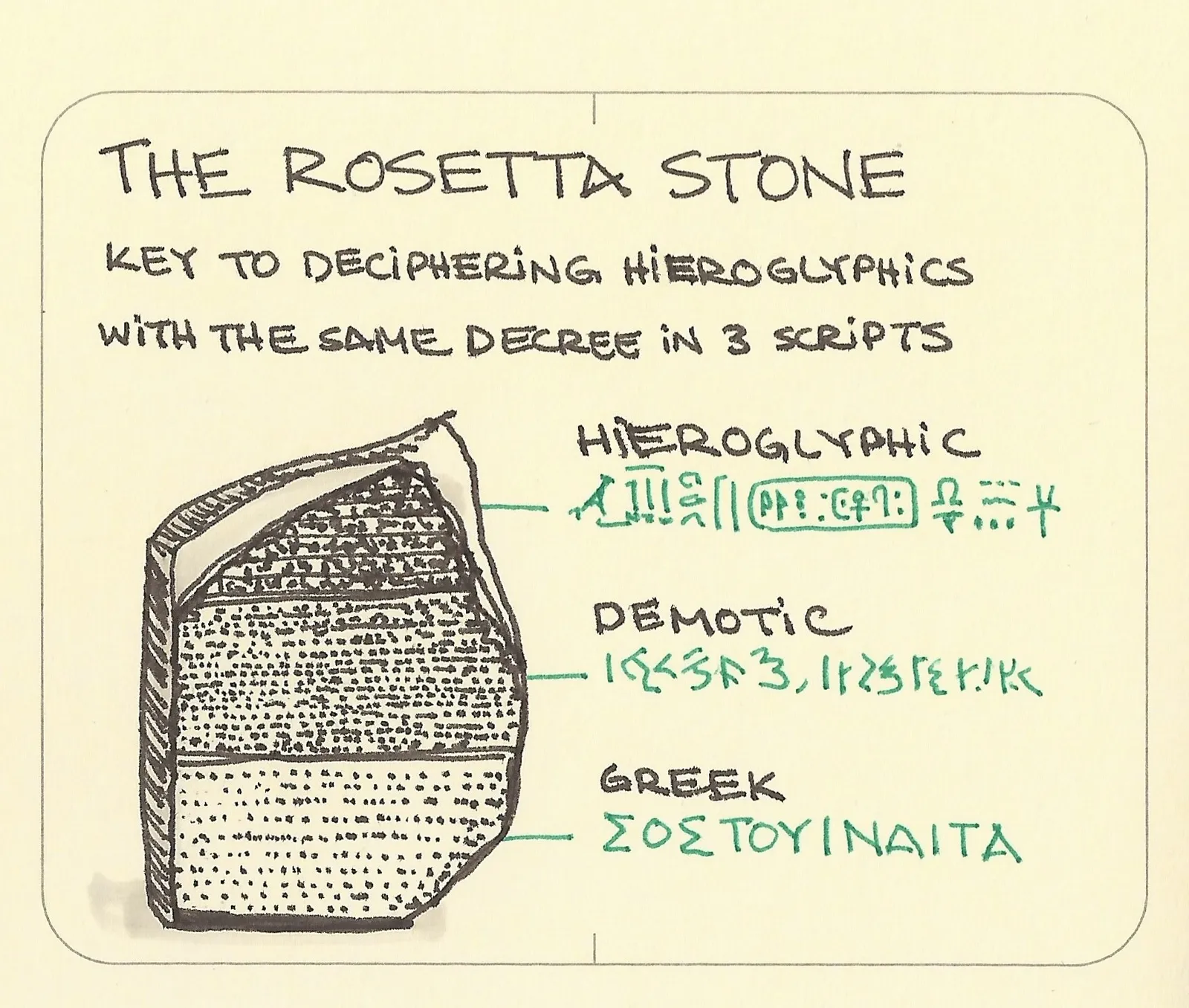
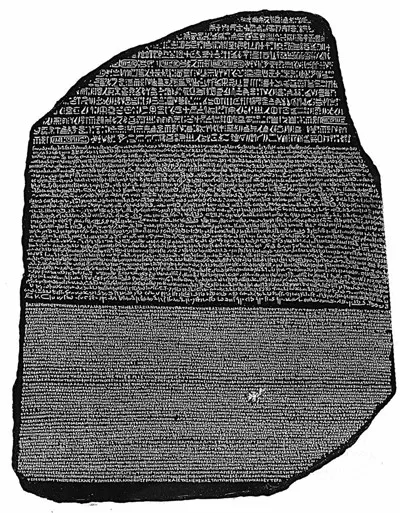
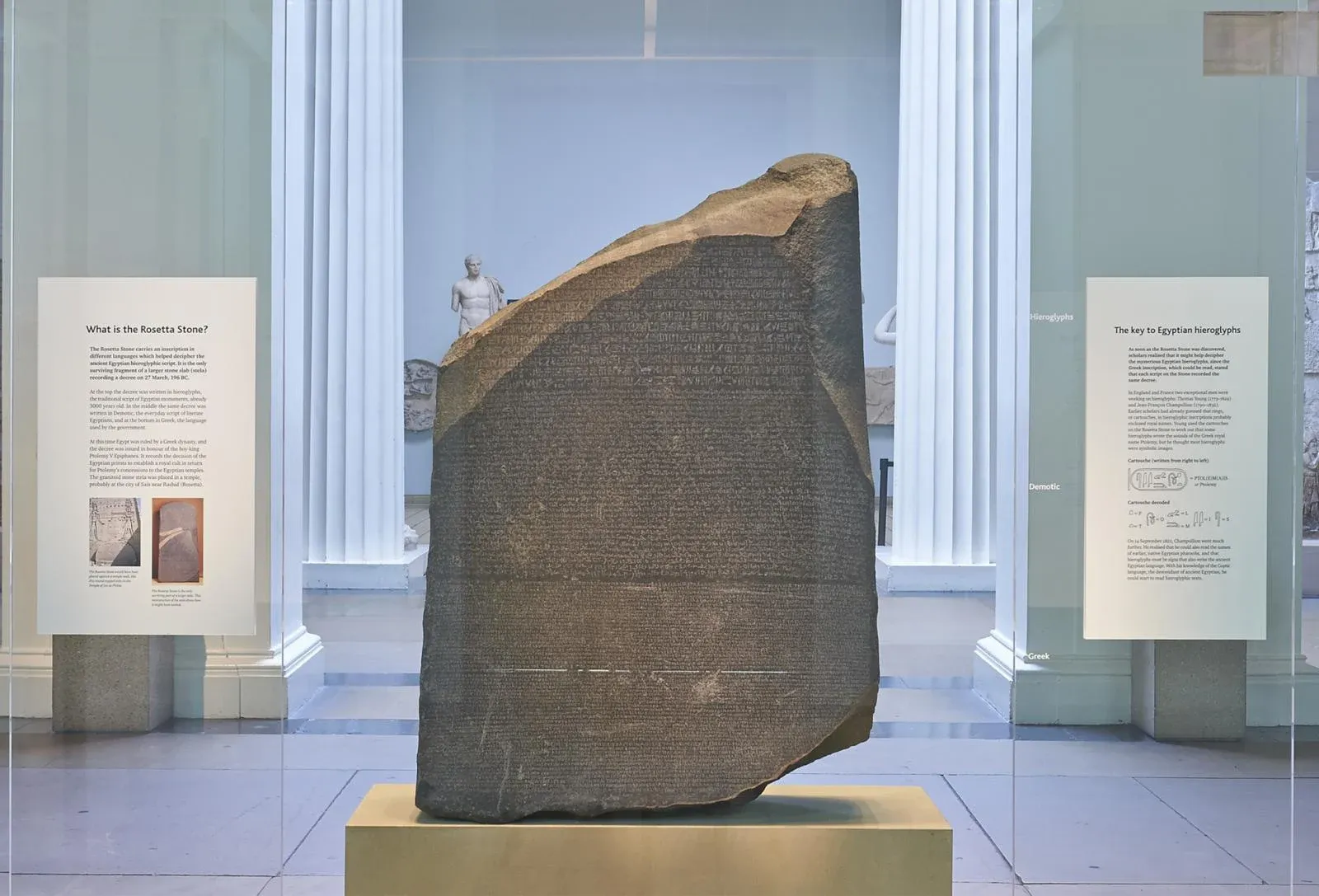
The stone contains a decree issued in 196 BC affirming the cult of Ptolemy V. The content itself is administrative and unremarkable. What matters is how it is encoded.
The same decree appears three times, representing three distinct data structures:
This is usually framed as "translation." But structurally, it is closer to representation learning.
Each script encodes the same semantic content at a different level of abstraction, optimized for a different inference task and audience. Meaning is conserved, but the affordances change.
Visually, the stone reads like a branching system: sparse symbolic forms at the top, dense explicit forms at the bottom. This is not unlike a modern model stack, where the same signal is re-expressed across layers—compressed, expanded, or reweighted depending on the goal.
This is where the comparison to modern AI becomes concrete rather than poetic. In contemporary machine learning, we see a similar "trilingual" split in how we process information:
All three architectures can operate on the same input. What differs is not the data, but how it is represented and navigated.
Seen this way, the Rosetta Stone is not just multilingual. It is multi-architectural.
It demonstrates something humans figured out early and AI is now rediscovering: the hard part is not generating content, but choosing the right representation for the reader, the task, and the medium.
This is why architecture and language keep converging—whether in temples, administrative scrolls, or neural networks. Each is an attempt to stabilize meaning while allowing it to travel across contexts.
The Rosetta Stone worked because it did not privilege a single encoding. It accepted redundancy as the price of understanding.
That remains true.
Gallery (3-col):
I thought it'd be fun to recreate this but representing the common neural networks CNN, RNN, and transformers.
Gallery (3-col):
Download the original rosetta stone model here
History / Writing Systems
Representation & AI
AI & Art / Systems Thinking
How ancient Herculaneum papyrus scrolls were deciphered
This video is relevant because it details the Vesuvius Challenge mentioned in your intro, showing how AI "representation learning" was literally used to uncover the ink in the carbonized Herculaneum scrolls.